

Let me paint you a picture.
Rajan is a 38-year-old senior manager at a multinational in Gurugram. He earns well, has been saving for years, and has decided — finally — that 2026 is the year he buys his dream home. He has a budget. He has a clear list of requirements. He has intent.
He also has 14 browser tabs open. Three PropTech apps on his phone. A spreadsheet comparing 22 projects. A WhatsApp group of "serious buyers" who share contradictory opinions daily. And six brokers who each swear their listing is the one he cannot afford to miss.
Eighteen months later, Rajan still hasn't bought.
Rajan is not an exception. Rajan is the rule.
The Information Explosion That Nobody Planned For
Over the last decade, the Indian real estate sector has undergone a quiet revolution — not in construction quality, not in delivery timelines, but in the sheer volume of information available to the average buyer.
In 2010, buying a home meant visiting a site office, talking to one broker, and trusting your gut. In 2026, a buyer in Delhi-NCR can access thousands of listings across a dozen platforms, watch video walkthroughs of projects still under construction, read RERA filings, track builder litigation histories, compare price-per-sqft across micro-markets, and consume an endless stream of YouTube "experts" telling them exactly what to do — and exactly the opposite of each other.
On paper, this sounds like progress. And in many ways, it is. Buyers are more protected than they've ever been. RERA has brought accountability. Digital documentation has reduced fraud. Transparency that didn't exist a decade ago now does.
But here is the paradox nobody in this industry is talking about: the same information revolution that was supposed to empower buyers has, for a significant portion of them, done the exact opposite.
It has paralysed them.
More Data, More Doubt
At Propblitz, we interact with hundreds of buyers every month — across the premium, luxury, and ultra luxury segments in Gurgaon. What we hear, consistently, is not confidence. It's exhaustion.
"I've been researching for eight months and I feel like I know less now than when I started."
"Every broker tells me something different. I don't know who to trust."
"I saw a YouTube video saying this sector is overvalued. Then another saying it's the best time to buy. What is the truth?"
This is the reality on the ground. Not a lack of information — an overwhelming surplus of it, with no framework to process it.
Psychologists call this "information overload" — a well-documented cognitive phenomenon where too many choices and too much data actually reduce a person's ability to decide. The irony is that this problem, historically associated with consumer goods, has now fully arrived in one of the highest-stakes decisions of a person's financial life: buying a home.
This is particularly acute in the ₹3 crore and above segment. The buyers are intelligent and financially sophisticated. They are used to making complex decisions. But real estate — with its opacity, its broker ecosystem, its developer marketing machinery, and its complete absence of standardised information — defeats even the most analytical buyer.
The Three Traps Buyers Fall Into
Trap 1: Mistaking research for readiness.
There is a comforting illusion in research. As long as you're still researching, you haven't made a mistake yet. The spreadsheets grow. The tabs multiply. The decision stays safely in the future. Buyers tell themselves they're not ready — but what they're often doing is avoiding the vulnerability of commitment. More data becomes a shield against the anxiety of deciding.
The research phase has a legitimate end point. Most buyers don't recognise it when they reach it.
Trap 2: Treating all information as equally valid.
A RERA filing and a WhatsApp forward are not the same thing. A data-backed market analysis and a broker's verbal assurance about appreciation potential are not equivalent. But in the digital age, all information arrives through the same screen, with the same visual weight. Buyers have no reliable filter. They can't easily distinguish signal from noise — so everything becomes noise.
This problem is especially severe in Gurgaon's new launch market, where developer marketing budgets are substantial and the information environment is heavily shaped by commercial interests. We have written about how to evaluate ultra luxury new launches independently — without relying on developer-supplied information — in an earlier article: Not Every Ultra Luxury New Launch in Gurgaon Deserves Your Money.
Trap 3: Waiting for certainty in an inherently uncertain market.
Real estate will never offer certainty. Markets move. Interest rates shift. Micro-markets evolve. Buyers who are waiting for the perfect moment — the ideal price, the ideal project, the ideal conditions — are waiting for something that doesn't exist. And the more information they consume, the more potential risks they discover, and the longer they wait.
In Golf Course Road's ultra luxury segment specifically, this trap has cost buyers crores. Prices in this corridor have not corrected meaningfully in 14 years — not through COVID, not through interest rate cycles, not through slowdowns. Waiting for a correction in a genuinely undersupplied premium corridor is not patience. It is hope masquerading as strategy.
The Proptech Industry's Blind Spot
Here's where I want to be honest about the industry I operate in — including ourselves.
Proptech, as a sector, has been obsessed with data. More listings. Better filters. Smarter search. Virtual tours. AI-driven recommendations. Price analytics. All genuinely useful innovations. But the industry has been building tools that answer the question "What is available?" — when the question buyers actually need answered is "What is right for me?"
There is a massive gap between information and insight. The industry has flooded the market with the former while neglecting the latter.
The best real estate decision a buyer can make isn't the result of having more data. It's the result of having the right framework — understanding their own priorities, their financial reality, their life stage, their risk tolerance, and their non-negotiables — and then mapping that framework against a curated, trustworthy set of options.
That's a fundamentally different product than what most of the industry is building. And it's the gap that structured advisory — as opposed to listing aggregation — is positioned to close.
What "Empowered" Actually Looks Like
A truly empowered buyer is not one who has read everything. It's one who knows what to ignore.
Empowerment in real estate looks like this: a buyer who walks into a site visit knowing exactly which three questions to ask the developer. Who can read a floor plan and immediately assess livability for their specific household. Who understands the difference between carpet area and super built-up area without needing a Google search. Who knows that the "pre-launch price" being offered is not necessarily a deal — and can articulate exactly why.
Empowerment is not about volume. It's about clarity. And clarity requires curation, not accumulation.
The most impactful conversations we have at Propblitz are not the ones where we show buyers more options. They're the ones where we help buyers eliminate options — and feel genuinely confident about the elimination. When a buyer can say, with conviction, "I'm not considering this project because of X and Y," they've moved from confusion to clarity. That's the shift that leads to a decision.
NRI buyers face an amplified version of this challenge. Evaluating Gurgaon's ultra luxury market from Dubai, Singapore or London — where developer marketing is aggressive and ground-level verification is nearly impossible — makes the information-to-insight gap even wider. We've written about the specific misconceptions NRI buyers carry into the Gurgaon market here: Why NRI Buyers Are Getting Gurgaon Wrong.
A Call to the Industry
If you're building in proptech: when a buyer uses your platform and closes their laptop, do they feel clearer or more confused?
If you're a developer: are your sales teams trained to help buyers make the right decision for them — even if that means walking away from your project?
If you're a broker: what would change if your incentive was tied to buyer satisfaction six months after purchase, not just at the moment of transaction?
These are uncomfortable questions. But they matter, because the homebuying journey in India is broken — not at the level of supply or demand, but at the level of trust and clarity.
The next phase of real estate advisory cannot just be about adding more features to existing products. It has to be about fundamentally reimagining what it means to serve a buyer. Not capturing their attention. Serving their decision.
The Bottom Line
In 2026, the Indian homebuyer has access to more information than any buyer in history.
And yet, the anxiety, confusion, and decision fatigue around buying a home has never been higher.
That is not a data problem. That is a clarity problem.
Solving it is not about building a better search engine. It's about building something far more human: trust.
That's the work we do every day at Propblitz — for buyers who are serious about Gurgaon's premium and ultra luxury market, and who want honest advisory over another listing portal. It's harder than aggregating data. It's slower than scaling a database. But it's the only thing that will actually matter — to the families who deserve to find the right home without losing their mind in the process.
About the Author
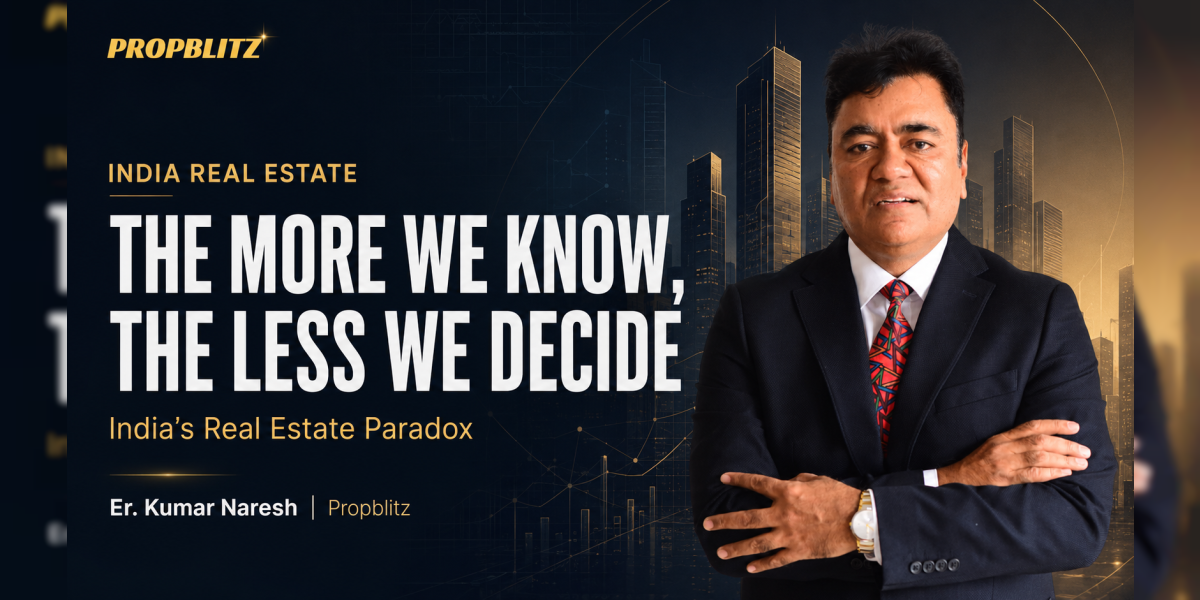
Er. Kumar Naresh is the Founder of Propblitz — Gurgaon's structured luxury resale and curated new launch advisory — and the Founder of BrokersADDA.com, a professional community of 1.4 lakh+ real estate professionals across India. He is the author of From Leads to Deals — a practical playbook for real estate professionals building structured, sustainable practices.
All advisory conversations at Propblitz are handled personally by Er. Kumar Naresh.
📖 From Leads to Deals — available on Amazon: https://shorturl.at/50yBA
Explore Propblitz Advisory
If you are seriously evaluating a premium or ultra luxury property in Gurgaon — our advisory covers independent project evaluation, developer due diligence, and honest guidance with no conflict of interest.
👉 Ultra Luxury New Launch Advisory — Gurgaon: www.propblitz.com/new-launches
👉 Trophy Properties — DLF Camellias, Magnolias & Branded Residences: www.propblitz.com/trophy-properties
👉 NRI Desk — Advisory for Overseas Buyers: www.propblitz.com/nri-desk
📲 WhatsApp Er. Kumar Naresh directly: https://wa.me/918287838025
© 2026 Propblitz. All rights reserved. HRERA Registration No.: GGM/825/2018/420/Ext1/2024/34