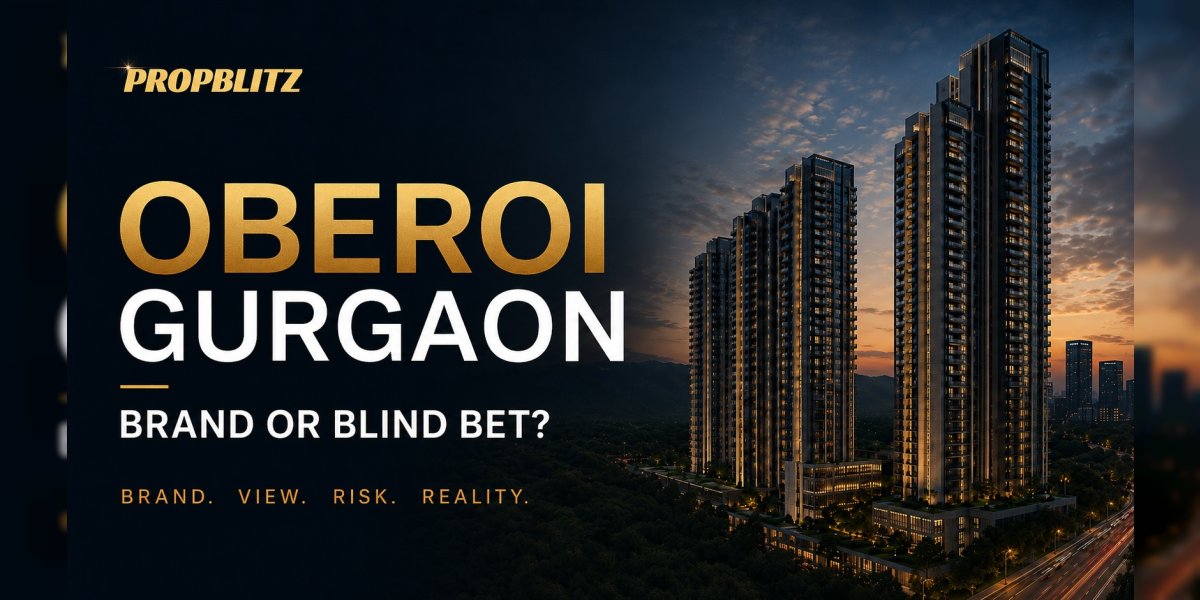


Walk into any ultra-luxury sales gallery in Gurgaon today and you will feel it before you understand it — the lighting, the fragrance in the air, the name on the wall that you have seen before on a handbag, a five-star lobby, or a sports car. Gurgaon now carries four branded residences anchored by names like Elie Saab, Trump, Westin and Tonino Lamborghini, and each one is engineered to make you feel something the moment you arrive.
That feeling is the product. And it is doing exactly what it was designed to do — move your decision from your head to your heart before you have asked a single hard question.
Let me be clear: I am not against branded residences. Some of them are genuinely excellent, and for the right buyer they make complete sense. But after years of advising buyers in the ₹5–100 crore range and well beyond, I can tell you one thing without hesitation — the brand should be the last thing you evaluate, not the first.
Here is how to evaluate one properly.
The first mistake buyers make is assuming the brand on the building is the builder. It almost never is.
A branded residence is, in most cases, a licensing arrangement. A developer pays a fashion house, a hotel group, or a luxury marque a fee — often a percentage of sales plus ongoing royalties — for the right to attach that name to the project, along with a set of design standards and, sometimes, a management service.
So before anything else, separate the three parties involved:
The brand owner — the name on the gate (the fashion or hospitality marque).
The developer — who actually builds, funds, and delivers the project.
The operator — who runs the services after you move in, if anyone.
These can be three entirely different entities with very different track records. The brand owner is selling you a feeling and lending its name. The developer is the one who will hand you the keys — on time, or three years late. Knowing exactly who is responsible for what is the foundation of every other question on this list.
A glamorous name on a poorly delivered building is still a poorly delivered building.
Once you know who the actual developer is, evaluate them the way you would evaluate any ₹10-crore commitment, brand or no brand:
Delivery history. How many projects have they completed, and did they hand over on the committed date? Past delays are the single most reliable predictor of future ones.
Financial strength. A luxury project that runs out of money mid-construction does not care how famous the brand is.
HRERA / RERA standing. Is the project registered, and is the registration current and clean? Pending or conflicting registration is a red flag, not a formality.
Litigation and disputes. A quick check of pending cases against the developer often tells you more than an hour in the sales gallery.
The brand is borrowed. The developer's competence is permanent. Weigh them accordingly.
This is where most buyers stop reading and most surprises begin.
Ask precisely what the brand is contractually obligated to deliver, and for how long. Is it only design and aesthetics? Or does it include managed services — concierge, housekeeping, hospitality-grade maintenance? And critically: what does that cost you every single month, for as long as you own the home?
Branded residences frequently carry brand-standard service contracts and elevated maintenance charges that are locked in for years. That recurring premium is part of the true cost of ownership, and it rarely appears in the headline price. A buyer who can comfortably afford the purchase can still be caught off guard by what it costs to keep it to brand standard.
Also ask the uncomfortable question: what happens if the brand licence is not renewed in fifteen years? Does the name come off the building? What does that do to your asset? You deserve a clear answer in writing, not a reassuring smile.
Strip away the marketing imagery and look at the home as a piece of real estate.
Layout efficiency — what is the carpet-to-super-area ratio? Branding does not change the fact that you are paying for usable space.
Ceiling heights, natural light, ventilation, and views — the things you will live with every day, long after the showroom magic has faded.
Floor plate and privacy — how many apartments share your floor and lobby?
Build quality and specifications — and whether what is promised in the brochure matches what is actually registered and approved.
Yahaan brand bikta hai, ghar baad mein aata hai — here the brand sells first, and the home comes later. Your job as a buyer is to reverse that order. A beautifully branded apartment with a clumsy layout is still a clumsy apartment.
Every branded residence carries a premium over a comparable non-branded luxury home in the same micro-market. That premium is not wrong — but you should know its size, and what you are getting for it.
Compare the per-square-foot rate against the best non-branded luxury projects in the same location, by the same calibre of developer. The difference is your brand premium. Then ask the only question that matters: does that premium convert into proportionate resale and rental value, or are you simply paying for the name?
Sometimes it does convert — a strong global brand can command durable premiums and attract a specific buyer. Sometimes it does not, and the premium quietly evaporates the day you try to sell. Knowing which one you are buying is the difference between an investment and an expensive feeling.
This is the question almost no one asks at the time of purchase, and almost everyone asks far too late.
Who buys this home from you in seven years?
Ultra-luxury and branded inventory sits in a thin segment of the market. The pool of buyers who can absorb a ₹15-crore-plus branded residence is small, and it can shrink quickly if too much similar inventory hits the market at once — which, with four branded residences now in Gurgaon, is a real consideration.
Look at the resale depth of comparable projects. How long do units take to sell? At what discount to the launch premium? Liquidity is not a glamorous topic, but it is the difference between an asset and an anchor.
Here is the part the industry would rather I did not write.
Most of the advice a buyer receives about which branded residence to choose is shaped — consciously or not — by which project pays the advisor the most. The buyer asks an honest question; the answer comes back tilted toward the higher commission. The brand glamour makes that tilt easy to hide.
This is precisely why I built Propblitz as a mandate-led, independent advisory with no commission bias and no conflict of interest. Not as a marketing line, but because at this ticket size, neutral advice is not a nicety — it is the entire value. When you are deciding between Elie Saab, Trump, Westin and Tonino Lamborghini, you do not need someone who is paid more to recommend one of them. You need someone whose only job is to tell you which one is right for you — and, sometimes, that none of them is.
Branded residences can be extraordinary homes. But the brand is a layer on top of the asset, not the asset itself. Evaluate the developer, the structure, the recurring cost, the premium, and the liquidity first — and let the name be the final, smallest factor in your decision.
At Propblitz, we say Structure is the New Luxury. When you are spending this kind of money, the structure of the deal, the developer, and the asset will protect you long after the showroom fragrance has faded. The brand never will.
If you are weighing one of Gurgaon's branded residences and want a genuinely independent read on it, that is exactly the conversation I exist to have.
Er. Kumar Naresh Founder, Propblitz — Independent, Mandate-Led Ultra-Luxury Real Estate Advisory, Gurgaon (HRERA Registered)
📍 Explore Gurgaon's branded residences, independently assessed: propblitz.com/branded-residences ▶️ Watch my video breakdowns on luxury buying: [https://youtu.be/hynpZngkfTY] ✉️ naresh@propblitz.com | Whatsapp : +91-8287838025